Manila, June 12 – Recognizing the selfless acts of gallantry of Filipino men and women in the service of the nation, Metrobank Foundation Inc. and the Rotary Club of Makati Metro recently named 10 awardees of The Outstanding Philippine Soldiers (TOPS) this 2011.
Metrobank Foundation president Aniceto “Chito” Sobrepena announced the TOPS awardees at the Lakambini Hall of the Armed Forces of the Philippines (AFP) Commissioned Officers Club inside Camp Aguinaldo in Quezon City.
The 10 awardees are Col. Daniel A. Lucero, MSgt. Sixto P. Navarrosa and CMSgt. Billy C. Benebile from the Philippine Army; Col. Alexander F. Balutan, TSgt. Rommel Carbon and Data Processor 3 Jairus M. Cenabre from the Philippine Navy; Col. Raul del Rosario, MSgt. Maria Teresa M. Bitong and MSgt. Nelson S. Mercado from the Philippine Air Force; and Col. Alexis Tamondong from the Technical Services.
Among the judges of the prestigious search is Presidential Adviser on the Peace Process Teresita Quintos Deles.
“In the peace process, the AFP is a major partner especially as it embarks on the new internal national peace and security plan of Bayanihan,” said Deles. “I am glad to participate in an effort that would highlight the good work of our soldiers as they impart their professionalism, resourcefulness and discipline.”
In her sharing to the media, Deles highlighted her experiences during the panel interviews. She related that she appreciated hearing how the new framework of ‘Winning the Peace,’ in which AFP is an integral part of the implementation process, is not just being discussed at the highest officer level but is now permeating into the perspectives of those in the rank and file.
Another member of the multi-sectoral Board of Judges is former AFP Chief-of-Staff, Muntinlupa Rep. Rodolfo F. Biazon who gave his highest compliments to the awardees and extended his congratulations by bidding them with the statement: “Soldiers, you make us proud.”
The event was attended by current AFP Chief-of-Staff General Eduardo Oban Jr. along with members of the Board of Judges including Associate Justice Jose Perez of the Supreme Court and De La Salle University President Mr. Narciso Erguiza FSC.
The TOPS awardees were chosen by Metrobank Foundation and the Rotary Club of Makati Metro among the many admirable men and women of the AFP who have made a mark while in service, especially in the name of nation-building.
They will be honored later this month in a ceremony expected to be graced by President Benigno Aquino III, and will also be presented with a cash prize of P300,000 each and trophy courtesy of Metrobank.
Showing posts with label opapp. Show all posts
Showing posts with label opapp. Show all posts
Saturday, June 11, 2011


Friday, June 10, 2011
GPH panel consults Tawi-Tawi local officials
This summary is not available. Please
click here to view the post.
Thursday, June 9, 2011
Cordilleran IP rights advocate takes NCIP helm
Manila, June 10 – Zenaida Brigida Hamada-Pawid, a Cordilleran and a staunch advocate of Indigenous People’s (IP) rights and current National Commission on Indigenous Peoples (NCIP) Commissioner representing the Cordilleras, on Tuesday took her oath of office as the new Chairperson of the Commission administered by Secretary Teresita Quintos Deles in a ceremony held at the Office of the Presidential Adviser on the Peace Process (OPAPP) headquarters in Ortigas, Pasig City.
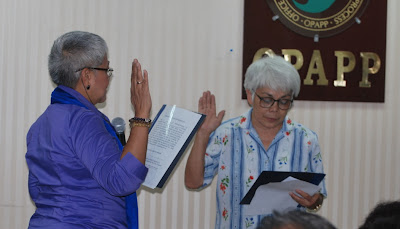
Present to witness the ceremony included relatives such as former communications director and chief peace negotiator Yong Afable; fellow NCIP Commissioners Dionisia Banua, Percy Brawner, and Conchita Calzado, Executive Director Basilio Wandag; and Viel Aquino-Dee, staunch IP advocate and sister of President Benigno Aquino III, among others.
Pawid, who is fondly called “Manang Briggs” by friends and fellow advocates, was first appointed as NCIP Commissioner in November last year. Her appointment was one of the first to be made by the President in the re-organization of the NCIP that became beleaguered with complaints from IP communities for allegedly facilitating entry of mining companies in ancestral domain areas over the communities’ protests.
A former member of the Cordillera People’s Forum (CPF), Pawid actively participated in the consensus building processes on the Social Reform Agenda that led to the crafting and passage of the Indigenous People’s Rights Act (IPRA), the law that created the NCIP as an independent agency that will formulate and implement plans and programs to promote and protect the rights and well-being of IP communities and recognize their ancestral domain as well as their rights.
Also known as a peace advocate, Pawid became a member of the government peace panel negotiating with the National Democratic Front of the Philippines during the Ramos administration. And in 2005, she was one of the 27 Filipinas nominated for the 2005 Nobel Peace Prize along with 1,000 women from different parts of the world.
Learning from Manang Briggs
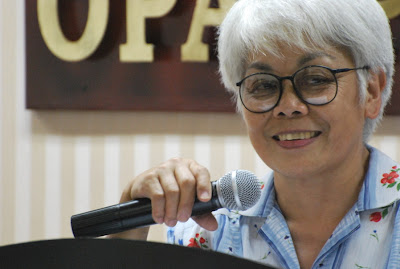
Deles, who had worked with Pawid as civil society advocates in the early years, said that she felt “awed” by the occasion of administering the oath to someone who taught her about ancestral domain.
The peace adviser who also acts as the cabinet oversight official on the NCIP, recounted days when she studied and understood ancestral land issues with Pawid. They would trek the mountains and sit at the table after meals to talk lengthily about IP issues.
“There was constant learning, not only conceptual learning but the stories of the people who in this difficult terrain have made a home, have made a monument of these rice terraces. It was awesome for me as a lowlander to realize that there were in fact parts of the Philippines that have memory of what we were before the colonizers came,” she narrated.
NCIP directions
In a message delivered after the simple oath-taking ceremony, the new Chair declared that one of the first things that NCIP will pursue is a legal audit of all the cases filed against the agency in relation to IPRA, as well as address the issues on CADTs or Certificate of Ancestral Domain Titles.
“Over and above everything else, we’ll seriously look at the CADT as the beginning of resource ownership management. That, perhaps, is the biggest problem of the NCIP,” she stated, adding that there are IPs who hold CADTs and CALTs (Certificate of Ancestral Land Titles) over their ancestral lands but it is other people who continue to benefit from these.
Pawid also said that they will try to lay a firm foundation for the NCIP by setting up a “truly credible and responsible database for IPs with the interpretation and analysis of all the data,” and by building a human resource pool in the NCIP.
The agency, she declared, will work on helping manage conflict that has erupted in IP areas especially since these have been frequent battlefields of government and New People’s Army (NPA) forces. “Because of this, the IPs are tagged as “communists not as communalists.”
Deles, congratulating Pawid, stated that part of NCIP’s responsibility is “to make sure that everyone will know what the IPRA law is all about.”
“I know it will be hard work. There are so many things that need to be done. This is the moment she (Pawid) has been called for and I can only give her the trust and confidence that she will be able to live up to the responsibility,” she stated. “I believe that she will be able to deliver that at the end of her term, the next chair will not have to pick up the pieces.”
Viel Aquino- Dee in a short message delivered before the oath-taking likewise expressed her optimism that Pawid can deal with the challenges NCIP has been faced with. “Knowing how huge the concerns are in the NCIP, I know that Manang Briggs can overcome the hurdles.”
Pawid’s appointment as NCIP Chairperson was made to replace Atty. Roque Agton Jr. who was appointed in the said position by the previous administration. Atty Agton will still remain in NCIP and continue as Commissioner for Southern and Eastern Mindanao until his term expires.
According to law, the Chairperson of NCIP is appointed by the President from among the commissioners.#

Present to witness the ceremony included relatives such as former communications director and chief peace negotiator Yong Afable; fellow NCIP Commissioners Dionisia Banua, Percy Brawner, and Conchita Calzado, Executive Director Basilio Wandag; and Viel Aquino-Dee, staunch IP advocate and sister of President Benigno Aquino III, among others.
Pawid, who is fondly called “Manang Briggs” by friends and fellow advocates, was first appointed as NCIP Commissioner in November last year. Her appointment was one of the first to be made by the President in the re-organization of the NCIP that became beleaguered with complaints from IP communities for allegedly facilitating entry of mining companies in ancestral domain areas over the communities’ protests.
A former member of the Cordillera People’s Forum (CPF), Pawid actively participated in the consensus building processes on the Social Reform Agenda that led to the crafting and passage of the Indigenous People’s Rights Act (IPRA), the law that created the NCIP as an independent agency that will formulate and implement plans and programs to promote and protect the rights and well-being of IP communities and recognize their ancestral domain as well as their rights.
Also known as a peace advocate, Pawid became a member of the government peace panel negotiating with the National Democratic Front of the Philippines during the Ramos administration. And in 2005, she was one of the 27 Filipinas nominated for the 2005 Nobel Peace Prize along with 1,000 women from different parts of the world.
Learning from Manang Briggs

Deles, who had worked with Pawid as civil society advocates in the early years, said that she felt “awed” by the occasion of administering the oath to someone who taught her about ancestral domain.
The peace adviser who also acts as the cabinet oversight official on the NCIP, recounted days when she studied and understood ancestral land issues with Pawid. They would trek the mountains and sit at the table after meals to talk lengthily about IP issues.
“There was constant learning, not only conceptual learning but the stories of the people who in this difficult terrain have made a home, have made a monument of these rice terraces. It was awesome for me as a lowlander to realize that there were in fact parts of the Philippines that have memory of what we were before the colonizers came,” she narrated.
NCIP directions
In a message delivered after the simple oath-taking ceremony, the new Chair declared that one of the first things that NCIP will pursue is a legal audit of all the cases filed against the agency in relation to IPRA, as well as address the issues on CADTs or Certificate of Ancestral Domain Titles.
“Over and above everything else, we’ll seriously look at the CADT as the beginning of resource ownership management. That, perhaps, is the biggest problem of the NCIP,” she stated, adding that there are IPs who hold CADTs and CALTs (Certificate of Ancestral Land Titles) over their ancestral lands but it is other people who continue to benefit from these.
Pawid also said that they will try to lay a firm foundation for the NCIP by setting up a “truly credible and responsible database for IPs with the interpretation and analysis of all the data,” and by building a human resource pool in the NCIP.
The agency, she declared, will work on helping manage conflict that has erupted in IP areas especially since these have been frequent battlefields of government and New People’s Army (NPA) forces. “Because of this, the IPs are tagged as “communists not as communalists.”
Deles, congratulating Pawid, stated that part of NCIP’s responsibility is “to make sure that everyone will know what the IPRA law is all about.”
“I know it will be hard work. There are so many things that need to be done. This is the moment she (Pawid) has been called for and I can only give her the trust and confidence that she will be able to live up to the responsibility,” she stated. “I believe that she will be able to deliver that at the end of her term, the next chair will not have to pick up the pieces.”
Viel Aquino- Dee in a short message delivered before the oath-taking likewise expressed her optimism that Pawid can deal with the challenges NCIP has been faced with. “Knowing how huge the concerns are in the NCIP, I know that Manang Briggs can overcome the hurdles.”
Pawid’s appointment as NCIP Chairperson was made to replace Atty. Roque Agton Jr. who was appointed in the said position by the previous administration. Atty Agton will still remain in NCIP and continue as Commissioner for Southern and Eastern Mindanao until his term expires.
According to law, the Chairperson of NCIP is appointed by the President from among the commissioners.#
Friday, June 3, 2011
Statement of Presidential Adviser on the Peace Process Teresita Quintos-Deles Regarding the NDFP’s proposal to defer peace talks and demand to release consultants
The statements made by National Democratic Front of the Philippines' (NDFP) chief negotiator Luis Jalandoni and NDF panel member Fidel Agcaoili are most unfortunate.
I would like to refer to the statements made in January of this year, of government chief negotiator Alexander Padilla, after the preliminary negotiations between the government and the NDFP. I quote negotiator Padilla, who said in his statement that “the government agreed to work, on best effort basis, for the release of NDFP consultants and personalities who are qualified under the JASIG so they may meaningfully participate in the negotiations."
"The resumption of the formal negotiations with the NDFP will focus on the remaining substantive agenda on: socio-economic reforms, political and constitutional reforms and end of hostilities and disposition of forces. To avoid unwarranted disruptions of the negotiations, the Parties also established sidetable mechanisms to review and address procedural and non-substantive issues such as JASIG implementation, the release of alleged political prisoners (APOs), and confidence-building and goodwill measures."
In line with this, the Government reiterates its sincerity and commitment to this process. In fact, in February of this year, before the start of the formal talks in Oslo, Norway, we facilitated provision of travel documents for NDFP Reciprocal Working Committee on Socio Economic Reform (RWC-SER) members Rafael Baylosis and Randall Echanis and NDFP consultant Angelina Bisuna Ipong. Likewise, the GPH took effective remedies to ensure the participation in the February talks of NDFP consultants Vicente Ladlad and Elizabeth Principe.
As far as I know, there has not been any changes on the agreements between the government and the NDFP. Preparations for the substantive agenda are moving forward. The Panel is fully aware of the developments brought about by the statements issued by Jalandoni and Agcaoili. I am confident that the Panel will manage this issue well and shall release its own official statement soon.
I am also confident that given the opportunity, the mechanisms set-up by both Parties to address the non-substantive issues will work towards the resolution of this issue. We enjoin the NDFP to continue having faith in this mechanism. The government remains committed to stay the course and discuss whatever it takes to bring a just and lasting peace for the country.
Friday, May 27, 2011
UNWFP’s ‘Walk the World’ to feed hungry kids in Mindanao conflict areas
Manila, May 28 – On May 29, Sunday, around 3,000 Filipinos will walk the streets to promote global awareness on the issue of child hunger and raise funds for child feeding programs in Mindanao conflict communities.
Spearheaded by the United Nations World Food Programme (UNWFP), the fundraising event dubbed “End Hunger: Walk the World” aims to feed the hungry and malnourished children in different countries. In Manila, it will be held at the SM Mall of Asia (across Music Hall) in Pasay City from 5:30 a.m. to 10:00 a.m.
Proceeds of the event will go directly to the UNWFP’s school feeding activities in the conflict-affected areas in the south. The UN agency has been a key contributor in the Mindanao peace process by addressing the food security needs of vulnerable people in war-torn areas.
Together with its global humanitarian partners in the corporate world - TNT, Unilever and DSM – the UNWFP will lead participants in the traditional walk and five-kilometer fun run.
Registration fees of P 250 (for walkers) and P 500 (for runners) per participant will help ensure that one meal a day is delivered to the school children in Mindanao.
“End Hunger: Walk the World” is a worldwide event that will occur simultaneously in 24 time zones within 24 hours in 80 different countries.
Along with various organizations, the Office of the Presidential Adviser on the Peace Process (OPAPP), spearheaded by Secretary Teresita Quintos-Deles, is supporting the event.
Bike for Peace
On the same day, a peace campaign called “Bike for Peace 2011” will be held in Cotabato City.
Bringing the statement, “Going the Extra Mile for Peace in Mindanao,” the Government of the Philippines (GPH) peace panel for talks with the Moro Islamic Liberation Front (MILF), together with 500 bikers and peace advocates, will gather to pedal a 36-km route for promoting peace in the region.
The GPH peace panel initiated the event to gain heightened support from the public on the Mindanao peace process.
By 6:30 a.m., the 36-km bike fest will start at the Cotabato City Hall then pass through the town of Datu Odin Sinsuat, and end near the Municipal Hall of Upi, Maguindanao. #
Filipino people should own the peace process – GPH panel member
This summary is not available. Please
click here to view the post.
Tuesday, May 24, 2011
Environment advocates cite top conflict drivers in CASER focus group
Manila, May 23 – Advocates have underscored environment-related causes of armed conflict during a series of focus group discussions (FGDs) held recently by the government Reciprocal Working Committee on Socio-economic Reforms (RWC-SER).
The FGDs were part of the Government of the Philippines (GPH) peace panel’s efforts to draw feedback from various stakeholders on the ongoing peace process with the Communist Party of the Philippines-New People’s Army-National Democratic Front of the Philippines (CPP-NPA-NDFP).
Headed by panel member Ednar Dayanghirang, the RWC-SER conducted three FGDs that focused on the environment – specifically on Environmental Risks and Resource Access and Utilization. Joining him were RWC members Fr. Albert Alejo and Prof. Fernando Aldaba.
In one FGD participants maintained that rampant and irresponsible mining activities causing death and destruction to environment lead to armed conflict. They also pointed out that large-scale mining operations encroach on lands of indigenous peoples (IPs) sometimes “with the help of government forces.”
According to one participant, mining toxic wastes are detrimental not only to the environment, but also to the communities that depend on the environment for livelihood. “Mine tailings that go to rivers affect those who need it for their livelihood, such as fisherfolk and farmers,” he said.
Another issue tackled in the FGDs was the disaster preparedness of local governments, especially those in the eastern part of the country like the Bicol region. “These areas, the corridor of poverty, are usually hit by storms and are among the poorest in the country. These are also where the insurgents breed,” explained one participant.
Another participant said solving these problems would need creativity. He added that reforms should not only focus on government actions but also on changing the culture of today’s Filipinos.
Other FGDs conducted by RWC-SER covered issues related to IPs, urban land reform, fisheries and forest reform, inclusive growth, agrarian reform, industrial policy and agricultural development, and social protection.
Inputs from these were used by the Committee in drafting the government’s version of the Comprehensive Agreement on Socio-economic Reforms (CASER) which will be exchanged for review with the NDFP version two weeks before the first bilateral meeting in June.
CASER is one of three key agreements that the GPH and the NDFP agreed to complete within a timeframe of 18 months to three years. The other two are the Comprehensive Agreement on Political-Constitutional Reforms (CAPCR), and the Agreement on End of Hostilities and Disposition of Forces (EoH/DoF).#
Friday, May 20, 2011
Bikers to pedal ‘extra mile’ for peace in Mindanao
Cotabato City, May 20 – “Going the extra mile for peace in Mindanao” will be the statement of around 500 bikers and peace advocates who are expected to gather here on May 29 to pedal a 36-kilometer route for promoting peace in the region.
Biking enthusiasts, government officials, civil society organizations, and the military will unite for this peace campaign dubbed as “Bike for Peace 2011.”
The Government of the Philippines (GPH) peace panel for talks with the Moro Islamic Liberation Front (MILF) initiated the event to gain heightened support from the public on the Mindanao peace process.
By 6:30 a.m., the 36-km marathon will start at the Cotabato City Hall then pass through the town of Datu Odin Sinsuat, and end near the Municipal Hall of Upi, Maguindanao.
Participants from different groups have been invited to join the bike fest, some of which includes: Cotabato Off Road Enthusiasts (CORE); Karancho Motorcycle Club; Armed Forces of the Philippines (AFP) Eastern Mindanao Command (EastMinCom); AFP 6th Infantry Division (6ID); Initiatives for International Dialogue (IID); Mindanao Human Rights Action Center (MINHRAC); Mindanao People's Caucus (MPC), Nonviolent Peaceforce (NP); and Muslim Organization of Government Officials and Professionals.
The Upi local government unit will likewise conduct a medical mission at their town gymnasium during the event.
Under the Aquino administration, the MILF has resumed peace negotiations with the government, and the two parties are scheduled meet again for another round of formal exploratory talks in June this year.
The GPH panel is expected to submit its counterproposal to the MILF’s Comprehensive Compact which contains the Moro group’s starting position for a politically negotiated settlement. #
Wednesday, May 18, 2011
ARMM poll synchronization will aid Mindanao peace process - Deles
This summary is not available. Please
click here to view the post.
Deles urges non-profit groups to engage in peace process
MANILA, May 18 – Secretary Teresita Quintos-Deles of the Office of the Presidential Adviser on the Peace Process (OPAPP) has called on leaders and representatives of non-profit and charitable organizations to engage in efforts that would advance the peace process in the country.
During the 39th Annual General Assembly of the Association of Foundations (AF) held recently at the Asian Institute of Management in Makati, Deles urged them to help spur hope among the people, particularly when there are challenges surrounding the peace process.
“Don’t just put projects and feeding programs, but imagine with us to help communities understand peace, especially in times of disappointment and cynicism,” she said, likewise stressing the need to help poor communities become resilient to conflict.
Deles provided updates on the Aquino administration’s ongoing peace negotiations with the Moro Islamic Liberation Front (MILF) and the Communist Party of the Philippines-New People’s Army-National Democratic Front of the Philippines (CPP-NPA-NDFP).
She also cited possible areas in the peace process in which civil society can contribute. Among these include peacemaking through faithful advocacy, promotion and information dissemination, and providing technical support and advice.
Further, the peace adviser underlined President Benigno Aquino III’s policy thrust of exercising transparency and inclusiveness in the peace talks “with the aim to restore full confidence and trust in the process.”
OPAPP Undersecretary Luisito Montalbo, who also attended the event, briefed the participants on the Payapa at Masaganang Pamayanan (Peaceful and Resilient Communities) or PAMANA program, the government’s flagship peace and development program.
Concerns from civil society
During the open forum, one participant from a Mindanao-based foundation said that some civil society groups are reluctant to participate in government peace efforts for “fear of being tagged as part of the government’s anti-insurgency efforts.”
“Programs like PAMANA are perceived as counter-insurgency actions,” he stated.
On this, Deles said that it is but common to “be called bad names not only by people we talk to across the table, but by other people who do not agree that we should be helping these people.”
“But for government, it’s clear. We have responsibilities to the people. We do PAMANA because we are a responsible government,” she added. “Do we let them define us or we define what we should do and find the means to do it?”
Another participant from a foundation focusing on health care asked how is OPAPP responding to the situation of political prisoners who have been suffering from cancer, tuberculosis and other serious illnesses.
Deles replied that OPAPP is not an implementing agency. However, there are other government agencies involved in the peace process that are dealing with such concerns. “DOJ (Department of Justice) Sec. Leila de Lima, who valiantly headed the Commission on Human Rights, has these items on her table,” she said, adding that reports like this should contain specific details for OPAPP to work on.
On the issue of education in conflict areas, one participant lamented that education is a priority of the administration, but when Muslim and Lumad communities ask for financial assistance to improve education in their areas, the government would always have no funding for it.
Deles answered that the budget they are on this year was proposed by the previous administration that had a different agenda.
The participants thanked the peace adviser for providing a comprehensive report on the peace process and clarifying certain issues.
They likewise lauded the efforts of the government to strengthen women participation in the peace process with the presence of women peace negotiators – Miriam Coronel-Ferrer for talks with the MILF, and Jurgette Honculada and Lourdes Tizon for talks with the CPP-NPA-NDFP.
The AF is a network of non-government organizations formed in 1972. Among its notable members are SM Foundation, ABS-CBN Foundation, Aboitiz Group Foundation, Childhope Asia Philippines, E. Zobel Foundation, Habitat for Humanity Philippines Foundation, and many others. #
Monday, May 9, 2011
GPH Panel Member speaks to top humanitarian journalists
GPH Panel Member speaks to top humanitarian journalists
Manila, May 10 – Government peace negotiator for talks with the Moro Islamic Liberation Front Miriam Colonel-Ferrer on Saturday spoke before finalists of the first Red Cross Humanitarian Reporting Awards.
In a forum prior to the awarding ceremonies, Ferrer shared her observations on Philippine media coverage of conflicts and peace processes.
“The armed conflict and the peace negotiations are highly visible in the media. This shows that the peace processes have remained in the national agenda,” Ferrer stated as she started her lecture.
She also said that efforts to make media more responsible and sensitive to reporting conflict have borne fruit, adding that what counts as news on the armed conflict have broadened.
“It’s no longer just the body count,” she observed.
However, Ferrer believes that there is still room for improvement in media’s reportage, such as the need for journalists to discuss concepts, not just report on events. For accuracy and deeper analysis, she also stressed the importance of securing and studying facts and data from diverse and reliable sources.
Further, she discussed some of the things media should avoid, one of which is the propaganda trap. “Propaganda is war by other means,” she quipped.
Other things she mentioned to avoid are spins that lead to misunderstanding and the “AFP said, armed group said” method of constructing a story.
“While this ‘he said, she said’ method may be an honest attempt at objectivity, it doesn’t provide a conclusion. It doesn’t leave the audience better off or with a clear understanding on who or what to support.”
Peace as the bottom line
Ferrer also recognized the role of 'netizens' or active internet surfers as writers for peace. In interactive websites where negative and thoughtless comments proliferate, she recommended that 'netizens' must raise the level of discourse and make it substantial. “Let’s keep up the discourse on the folly of war and the need for a peaceful settlement of the armed conflict. Let’s move away from name-calling.”
“The bottom line is that we have to build a national consensus that our problems cannot be solved by war, that it makes sense to report peace and peaceful means to end conflict,” Ferrer ended her lecture.
Other speakers and guests
Aside from Ferrer, two notable members of the media also served as resource persons of the forum.
Jason Gutierrez of the Agence France Press shared his experience as an embedded war correspondent while Antonio Cruz of tonyocruz.com spoke on his observations on the role of new media in conflict situations.
The International Committee of the Red Cross (ICRC) communication coordinator Anastasia Isyuk for her part presented how the International Humanitarian Law (IHL) protects journalists and helps in conflict reporting.
Christoph Sutter, ICRC deputy head of delegation, and Philippine Red Cross Chair Dick Gordon each gave a salute to the journalists present, both underscoring the bravery of the press in light of the difficult and dangerous field they decided to cover.
“I am here to pay tribute to your bravery in bringing issues not often being reported…on your bravery to report what needs to make sense,” Sutter said.
Gordon, for his closing remarks, mentioned that “humanitarian reporting may not be as ‘salacious’ as what editors would want in a news story, but it behooves all of us to pay attention. It is about time we put these issues on the front pages.”
Awardees
“We have seen civilians targeted in armed conflicts. We believe that the best way to achieve stronger protection is to respect IHL. The media’s voice should be heard in favor of proper and responsible behavior in wars. Media, therefore has a responsibility to influence public opinion, weapon bearers and governments to avoid any encouragement to violate the IHL,” Isyuk stated.
The first Red Cross Humanitarian Reporting Awards were given to journalists who reported on civilians often forgotten or dismissed as “collateral damage” of war.
Isyuk said that conflict-sensitive reporting is one of the criteria for the selection of winners. This entails that the report or entries do not stereotype or label people or groups; not take advantage of the victims’ plight, but rather encourage the readers to move into action.
First prize winners include Frinston Lim of the Philippine Daily Inquirer-Mindanao for his in-depth story “Women grieve over land mine deaths” (print category); Marya Salamat of Bulatlat.com for her story entitled “Child rights advocates bewail distortion of child protection principles for counter-insurgency” (online category); and Ed Lingao of Philippine Center for Investigative Journalism (PCIJ) for his documentary “Maguindanao, isang taon” (TV/radio category).
There were 23 finalists from a crop of 60 entries submitted to the Red Cross.
Coming from the mainstream media are finalists and recipients of special citations from the Philippine Daily Inquirer, The Philippine Star, Manila Bulletin, and Malaya (print) ; Al Jazeera, PCIJ, and GMA-7 (TV/radio); and GMAnews.tv, Bulatlat.com, MindaNews, and VeraFiles (online).
The community media was also represented by finalists and recipients of special citations from SunStar Davao, The Mindanao Cross, Zamboanga Sibugay Tribune, DXND-AM in Kidapawan City, The Mountain Province Exponent and The Catarman Weekly Tribune.
Isyuk said that some of the issues highlighted by the contestants include media safety; plight of internally displaced people; peacebuilding initiatives and community projects; problems of children affected by conflicts; and indiscriminate use of weapons. #
Thursday, May 5, 2011
AFP verifies legitimacy of CPLA head, backs closure agreement with gov’t
Manila, May 5 – The Armed Forces of the Philippines (AFP) today verified the legitimacy of the leadership of Arsenio Humiding, chairman of the Cordillera People's Liberation Army (CPLA) and ensured support for the armed group’s closure agreement with the government.
“The CPLA is legitimately led by Arsenio Humiding, his group is what we recognize,” said Brig. Gen. Jose Mabanta Jr., AFP Deputy Chief of Staff for Operations (J3).
The CPLA, an armed group of indigenous peoples in the Cordilleras which split from the New People’s Army (NPA), signed the Mt. Data Peace Accord in September 1986 under the administration of the late President Corazon C. Aquino.
Mabanta rejected claims of other parties that they are the recognized CPLA, calling them "rogues".
The CPLA has submitted a manifesto to us wherein all zone commanders pledged allegiance to the leadership of Chairman Humiding. he said.
Humiding took his oath as CPLA Chairman on April 3 during the Cordillera Bodong Administration (CBA)/CPLA Political Bureau Conference in Baguio City.
Meanwhile, Mabanta issued support for the closure agreement that the government and CPLA will sign tomorrow, May 6.
"This is peace and development we are ushering, and the signing that will happen between CPLA and our government shows what I thoroughly believe in, a holistic people-centered strategy in winning the peace.”
Mabanta, on his oath taking as AFP’s new operations chief, ensured the public with an appropriate execution of the new Internal Peace and Security Plan (IPSP) also known as “Bayanihan” which is focused on the approach of “winning the peace.” #
Tuesday, April 26, 2011
GPH holds another consultation before talks with MILF
GPH holds another consultation before talks with MILF
Manila, Apr. 26 - Before heading to Malaysia for the next round of talks, the Government of the Philippines' (GPH) panel negotiating with the Moro Islamic Liberation Front (MILF) sat down with several political leaders, mainly from the Liberal Party, on Monday as part of the effort to achieve transparent and accountable peace negotiations.
The National Institute of Policy Studies (NIPS) and the Friedrich Naumann Foundation for Liberty (FNF) spearheaded the forum dubbed as “Peace in Mindanao” held at Dusit Thani Hotel in this city.
NIPS is a political institute that undertakes programs for the promotion of liberalism and democracy in the Philippines while FNF is an international foundation that promotes freedom and liberalism through civic education, political dialogues, and political counseling.
Some 30 participants composed of congressmen, cabinet members, political leaders and lawyers gathered in the forum where Presidential Peace Adviser Teresita Quintos-Deles and GPH panel chair Marvic Leonen presented the current status and context of the negotiations with the MILF.
“This is an endeavor to be transparent and accountable to the proposals that we are giving on the negotiating table,” Leonen previously said about the series of consultations that the panel is conducting with various sectors.
To date, the GPH panel has conducted consultations with different sectors including the academe, civil society organizations, local government officials, and the military.
Secretary Deles, on the other hand, hopes that the consultations with political leaders will continue to roll as it aids the progress of the peace process.
“We now have a formal start of what I hope will not be a one-time conversation but a continuing one because it is supposed to accompany the (peace) process,” Deles said.
Some of the officials present in the forum are Sec. Lualhati Antonino of the Mindanao Development Authority; Undersecretary Jose Luis Gascon of the Office of the Presidential Adviser on Political Affairs; Liberal Party President Manuel Roxas; Muntinlupa Rep. Rodolfo Biazon; Zamboanga City 1st District Rep. Maria Isabelle Climaco; Maguindanao 1st District Rep. Bai Sandra Sema; and North Cotabato 1st District Rep. Jesus Sacdalan.
Meanwhile, Deles, during the forum, stressed the “issue of ownership” in crafting a sustainable peace process.
“It is important for us to have this conversation because the issue of ownership of the peace process is very important. For the peace process to be sustainable, it has to be owned by the people,” she noted.
Likewise present in the forum are GPH panel members Miriam Coronel-Ferrer, Senen Bacani, and Ramon Piang, Sr., and members of the panel secretariat.
The government and the MILF panels will hold their 21st formal exploratory talks tomorrow, April 27, until Thursday, April 28, in Kuala Lumpur, Malaysia.
Among the issues that the government will raise are concerns regarding MILF commander Ustadz Amiril Umra Kato, who allegedly broke away from the Moro group, and the MILF’s Comprehensive Compact which contains its standing position on substantive issues.#
Subscribe to:
Posts (Atom)